






Creating a mind map while reading helps turn chapters, characters, and ideas into an organized overview of a book. In this guide, you will learn how to make a mind map of a book using Dom Casmurro as an example, with a process that also works for books assigned for university entrance exams, college courses, or personal reading.
Dom Casmurro, a novel by Machado de Assis published in 1899, is available in the digital collection of the Machado de Assis – Life and Work portal. Since the novel is narrated retrospectively by Bento Santiago, separating narrated facts, memories, and interpretations helps you study without reducing the work to a single answer.
What to put at the center of the mind map
The center should contain the book’s title. Write “Dom Casmurro” and add the author if you wish. The rule is simple: the center represents the subject that organizes all the other branches. When learning how to make a mind map of a book, start with the main subject instead of trying to summarize every page.
Define the main branches before adding details
For a literary work, use five to seven broad branches. In this example, the branches are context and author, narrator, characters, plot stages, themes, narrative techniques, and review questions. This structure leaves room for essential information without turning the map into a copy of your notebook.
- Context and author: Machado de Assis, publication in 1899, and its relationship to Brazilian Realism.
- Narrator: Bento Santiago narrates in the first person and reconstructs past events.
- Characters: Bentinho, Capitu, Escobar, Ezequiel, and Dona Glória.
- Plot: childhood, the seminary, friendship with Escobar, marriage, jealousy, and Bento’s later account.
- Themes: memory, doubt, jealousy, social relationships, and the construction of truth.
- Narrative techniques: dialogue with the reader, gaps, and ambiguity.
Example of a Dom Casmurro mind map
Este mapa foi criado no REAZLY a partir dessa estrutura. Use-o como referência de organização, não como substituto da leitura: ao estudar, adapte os ramos às anotações e aos capítulos que você leu.
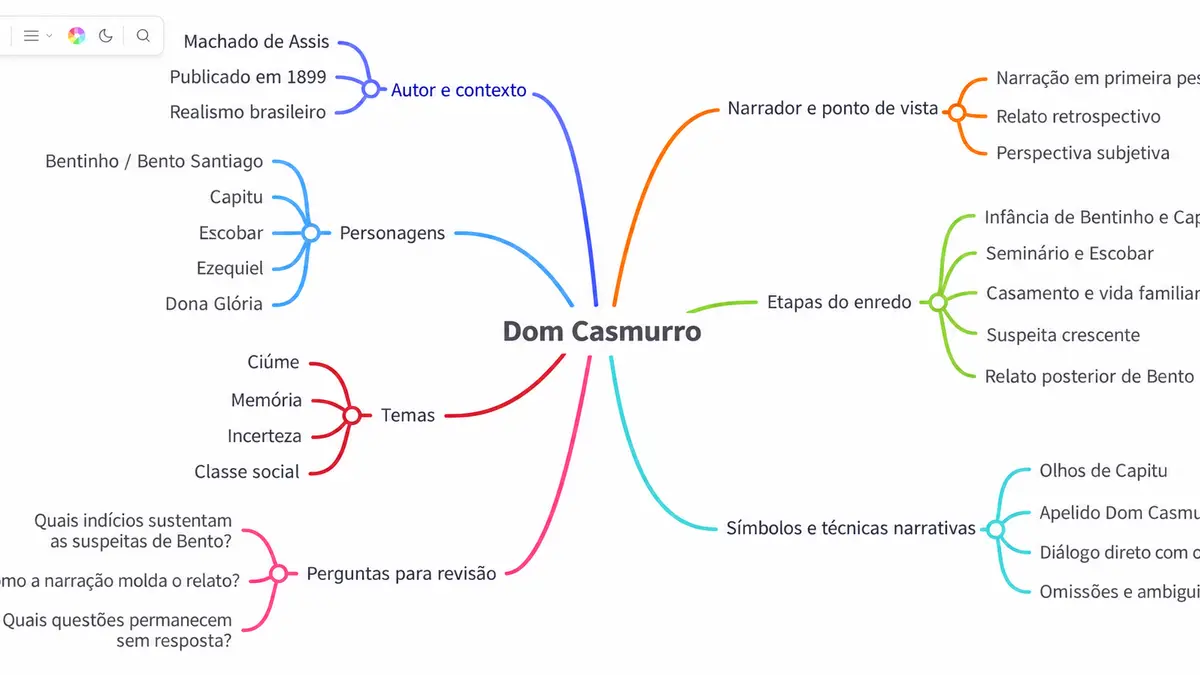
Portuguese mind map of Dom Casmurro created in REAZLY to organize reading and review.
How to select useful keywords
In a mind map, each node should convey a short idea. Instead of writing “Bentinho suspects that Capitu betrayed him,” record “Bentinho’s suspicion” in the plot or themes branch. Then add sub-branches with passages, questions, or chapters that support the note. This care matters because the narrator does not provide a definitive answer, and interpretation is part of reading.
When learning how to make a mind map of a book, replace long sentences with words that bring back the complete idea during review. Good nodes do not need to make sense to everyone in isolation; they need to make sense to you when you revisit the text.
Organize the plot without losing the sequence
Create a concise sequence of events. In Dom Casmurro, it can begin with Bentinho and Capitu’s relationship, continue to the promise of entering the seminary, include the friendship with Escobar, move on to marriage, and end with Bento’s growing suspicion and his account in later life. There is no need to list every chapter: choose turning points that change relationships, conflicts, or the narrator’s perspective.
This is one of the most practical aspects of how to make a mind map of a book: the map quickly reveals where the story changes direction. If a branch grows too large, divide it into “beginning,” “conflict,” and “ending,” or use chapters as sub-branches.
Include questions to turn a summary into review material
After the content branches, add open-ended questions. For this example, try: “How does first-person narration influence what we know?”, “What evidence does Bento present?”, “What remains unanswered?”, and “What social relationships appear in the novel?”. These support active review: try answering without looking at the book and use the map only to check what you forgot.
The Machado de Assis bibliography at the Brazilian Academy of Letters also lists Dom Casmurro among the works from 1899. This can go in the context branch when an assignment calls for information about the author and period.
Review and simplify the map
Before finishing, make three checks. First, does each branch answer a different question? Second, are there words that repeat the same idea? Third, could someone see the major themes without reading the details? If not, move or merge the nodes.
You now have a guide to how to make a mind map of a book: place the work at the center, define branches that answer your reading questions, record keywords, organize the plot’s turning points, and finish with questions. Open a map in REAZLY and test this method with your next book.
Ready to create your first mind map?
Organize your ideas in Reazly and turn each concept into flashcards to study and remember.