

To study with English flashcards, choose an everyday situation, organize the expressions in a mind map, and turn each one into a review question. Try answering before checking the back of the card, then use the expression in a sentence of your own. In REAZLY, you can organize the topic visually, connect concepts to flashcard decks, and keep track of your reviews.
In this guide, we will use a simple example: introducing yourself in English. You will learn how to build a small map, create cards with context, and combine vocabulary review with language practice.
How do English flashcards work?
A flashcard has a question or prompt on the front and an answer on the back. When studying English, it might describe a situation in Portuguese and ask for an English expression, show a sentence with a blank, or present an expression whose meaning you need to recognize.
The key moment in a review comes before you reveal the answer: you try to recall what you studied. Then you check the back and assess whether you could answer, needed a hint, or do not yet know the expression.
Here is an example for beginners:
- Front: How do you say “Meu nome é Ana” in English?
- Back: My name is Ana.
- Practice: say the sentence again, replacing Ana with your own name.
This format gives the card a clear task. Instead of combining several rules or a long list of words, you practice one specific answer.
To organize this habit, see also how to plan a 25-minute study session.
Why combine flashcards with mind maps?
A mind map shows how ideas relate to each other. English flashcards let you practice questions about each idea. By combining the two, you keep the topic in context while also setting aside time to try answering without checking your materials.
Imagine a map with “Everyday English” as its central topic. A branch called “Introductions” brings together the expressions “My name is…” and “Nice to meet you.” When you open the map, you can see the situation in which you would use these phrases. When you review your English flashcards, you practice saying them and recalling their meanings.
The map organizes the content; the card guides the question. This distinction helps you decide what belongs in each tool: keywords and connections in the map, focused questions on the flashcards.
To learn more about how this tool is structured, read what a mind map is.
English flashcards: how to use mind maps in 5 steps
1. Choose a specific situation to study
Start with something manageable that you can practice: introducing yourself, asking for information, or talking about your routine. For this example, we will work with just two expressions for introductions.
Open REAZLY, sign in to your account, and open the mind maps area. Create a map manually with “Everyday English” as the central topic. Add an “Introductions” branch and, under it, the expressions “My name is…” and “Nice to meet you.”
This structure has just four nodes, including the central topic, arranged across three levels. It provides a starting point for putting the cards in context without turning the map into a long vocabulary list.
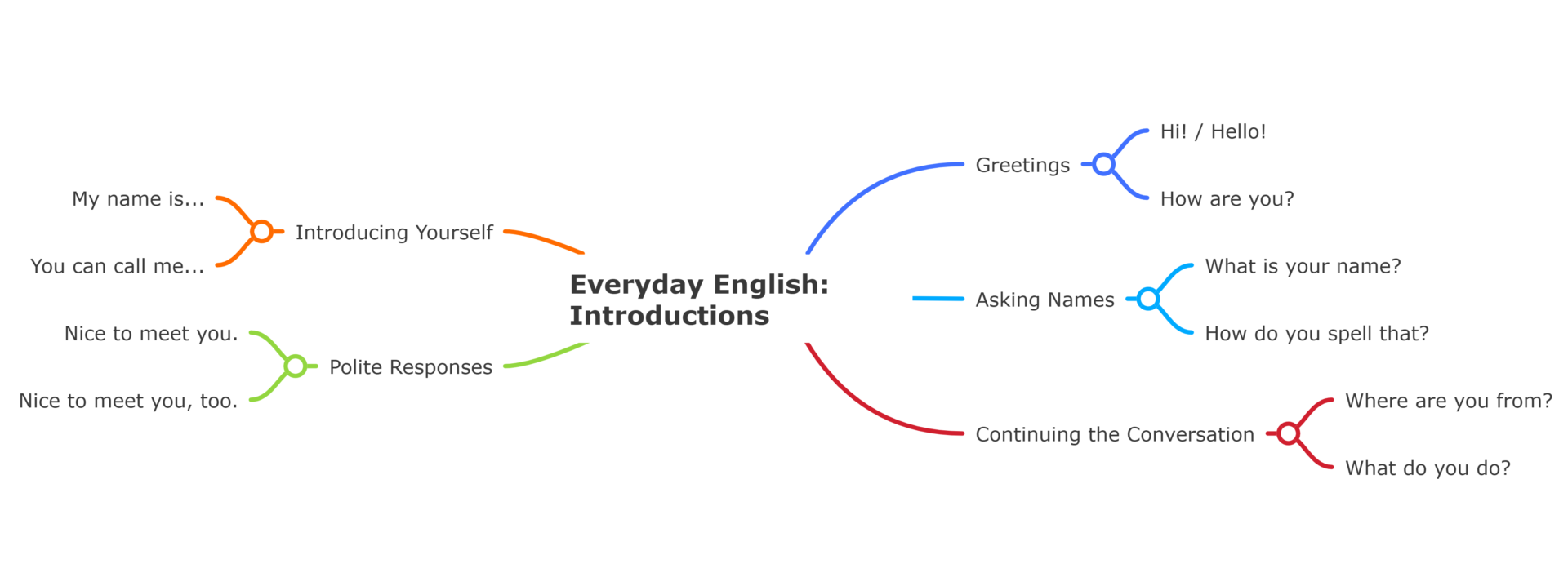
English introductions mind map: organize greetings and everyday expressions to create your flashcards.
2. Connect the topic to a flashcard deck
In REAZLY, concepts in a map can connect to flashcard decks. Use this structure to collect the cards for “Introductions” in a deck with the same name. This gives you a visual reference for the topic those questions belong to.
Create your English flashcards manually using the expressions in the example. Starting with a small number of English flashcards lets you check that the questions are clear before expanding your materials.
3. Write questions with a clear answer
For the first expression, create a card that asks for a self-introduction:
- Front: Complete the introduction in English: “Meu nome é Ana” → “_____ Ana.”
- Back: My name is Ana.
For the second, describe the situation in which the expression is used:
- Front: You have just met someone. How do you say “Prazer em conhecer você” in English?
- Back: Nice to meet you.
These English flashcards practice different tasks: completing a sentence and recalling an expression based on a situation. Choose the format that matches what you want to learn.
You can also create a comprehension question, such as “What does ‘Nice to meet you’ mean?” Use this format when your goal is to recognize the expression while reading or listening.
4. Review by trying to answer before checking
Open your English flashcard deck in REAZLY and start reviewing. Read the front of the card, try answering, and only then check the back. Rate your answer honestly so that the review record reflects how difficult you found it.
If you get it wrong, identify the specific issue: did you forget the whole expression, mix up a word, or interpret the question differently? If the prompt is ambiguous, revise the card before continuing.
Return to the map when you need to recall the context. Seeing that both expressions belong to “Introductions,” practice a short sequence: “My name is Ana. Nice to meet you.” Then replace the name with your own.
5. Use the expressions beyond your flashcards
After reviewing your English flashcards, write a short introduction or say both sentences out loud. This gives you a chance to use the material in a task that differs from the one on the card.
To check pronunciation, consult a dictionary with audio, such as the Cambridge Dictionary, or another reliable English resource. English flashcards and the map help organize your study; your routine also needs exposure to the language, listening, and opportunities to speak and write.
How to create effective English flashcards
Before adding new English flashcards to your deck, check the following:
- One task per card: ask for one expression, one piece of information, or one specific blank to fill in.
- Enough context: describe the situation when more than one translation is possible.
- A short, checkable answer: make it clear what you expect to recall.
- Checked English: check the spelling and usage of the expression in a reliable source.
- Content that is useful to you: prioritize situations that relate to your goals.
Avoid putting an entire conversation on the back of a card and expecting to reproduce it word for word. If you want to study a dialogue, split the expressions into smaller English flashcards, then practice the full sequence outside your review session.
Also avoid relying only on translations of isolated words. A short sentence can clarify the usage you want to practice. This is especially useful when a word has several meanings.
A simple routine to get started
Set aside time that fits your day to review your English flashcards. A first session could follow this sequence:
- Check your available reviews: start with the cards you are already studying.
- Try answering: check each answer after your attempt and record how difficult it was.
- Return to the context: check the topic in the map if you cannot remember when to use the expression.
- Put it into practice: write or say a sentence using the material you reviewed.
- Add new material gradually: add new expressions at a pace that allows you to keep reviewing.
The number of English flashcards should reflect the time you have and the difficulty of the material. If reviews start piling up, reduce the amount of new material and reassess cards that are taking too much effort.
Start with one map and two expressions
To put the method into practice, create an “Everyday English” map, add an “Introductions” branch, and organize the two expressions from the example. Then create the cards, review them, and use the sentences to introduce yourself.
In REAZLY, you can keep mind maps, flashcard decks, and reviews in one place. Start with this small example and adapt the questions to what you need to learn.
Frequently asked questions about English flashcards
Are flashcards suitable for complete beginners?
You can start with basic expressions, as long as you understand their meanings and check how they are used. Use introductory materials to learn the content and flashcards to review what you have already studied.
Should the front of the card be in Portuguese or English?
It depends on your goal. To practice comprehension, you can show the English expression and ask for its meaning. To practice expressing yourself, describe a situation or give a sentence in Portuguese and ask for an answer in English. The prompt needs to make the task clear.
Do I need a large mind map before creating flashcards?
No. The example in this guide has four nodes and already provides context for two expressions. Expand your materials as you find relevant content, keeping each topic easy to look up.
Are flashcards enough to learn conversation skills?
Flashcards let you review expressions you want to use, but conversation also requires understanding other people and forming responses during an interaction. Combine your reviews with listening and speaking practice suited to your level.
Ready to create your first mind map?
Organize your ideas in Reazly and turn each concept into flashcards to study and remember.