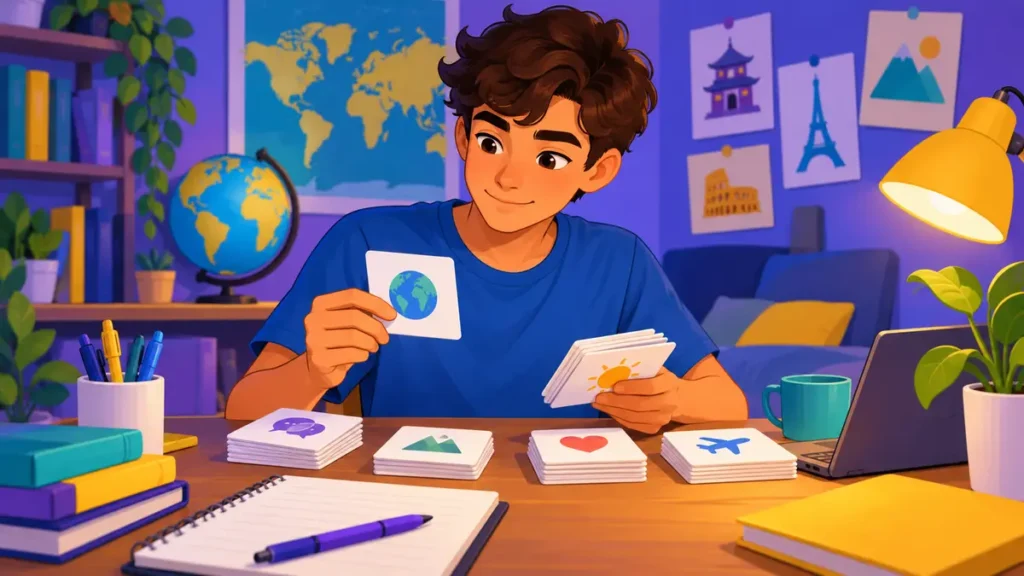
Learning a language involves encountering words, sounds, and structures many times. Flashcards for language learning help turn that exposure into active review: instead of simply rereading a list, you try to recall an answer before checking it.
The aim is not to create hundreds of cards in one day. It is to make clear cards that relate to real situations and are easy to review. In this guide, you will learn how to structure flashcards for language learning and fit them into a realistic routine.
Why do flashcards work for language learning?
A flashcard creates a useful pause between a question and its answer. When you try to recall a word, expression, or structure before flipping the card, you practice retrieving information. Recall does not need to be perfect: mistakes show you exactly what to review.
This is an important difference from simply looking at a translation. Retrieval practice aims to bring content to mind; afterward, you compare your attempt with the answer and correct what was missing. The material from the Learning Scientists on retrieval practice recommends using flashcards without peeking at the back and reviewing the material after your attempt.
For foreign language vocabulary, this type of practice becomes more valuable with feedback and repetition. A study on spoken vocabulary learning in a second language found better word comprehension and production when participants tried to produce the words before hearing the answer, compared with simply imitating pronunciation. You can read the study abstract on PubMed.
What makes a flashcard effective?
Flashcards for language learning work better when each one tests a small idea. A very broad card, such as “English verbs,” does not make clear what to answer. A specific question, on the other hand, lets you assess whether you really know.
- A clear cue: a word, an image, a situation, or a short question.
- A verifiable answer: the meaning, the correct form, the pronunciation you will check, or a model sentence.
- Enough context: a sentence showing how the word is actually used.
- An action before the answer: try saying, writing, or completing the sentence before flipping the card.
Avoid putting an entire paragraph on the back. If you need to memorize a lengthy explanation, break it into smaller questions. This makes your language learning flashcards quicker to review and easier to adjust.
Choose the card type for what you want to practice
There is more than one template. Vary the format according to the skill you are studying.
Word to meaning and use
Put the word in the target language on the front. On the back, record a simple meaning in Portuguese and a short sentence. For example, instead of creating a card with only “borrow = emprestar,” use a sentence such as “Can I borrow your pen?” and think of a situation in which you would ask to borrow something.
Situation to expression
Describe a situation on the front: “You have arrived at a hotel and want to confirm a reservation.” On the back, include an expression that would work in that context. This format brings language learning flashcards closer to a real conversation.
Fill-in-the-blank for grammar
Write a sentence with a blank and a short cue indicating what to practice. For example: “Yesterday, I ___ to the library. (go)”. Put “went” on the back and reread the complete sentence. If a card requires more than one rule, split it into two.
Image to word or sentence
An image can serve as a cue when you want to rely less on translation. Use simple illustrations of objects, actions, places, and situations that are easy to recognize. Then try naming or describing the scene in the language you are learning.
A practical template: from an isolated word to a card with context
Imagine you have encountered the word “appointment.” Instead of recording only the Portuguese meanings “consulta” or “compromisso,” create a question that requires you to use it.
- Front: How do you say in English that you have a dentist appointment at 3 p.m.?
- Back: “I have a dentist appointment at 3 p.m.”
- Extra review: say the sentence out loud and replace “dentist” with another situation from your routine.
This template combines meaning, context, and retrieval. It is a way to create language learning flashcards without getting stuck with disconnected lists.
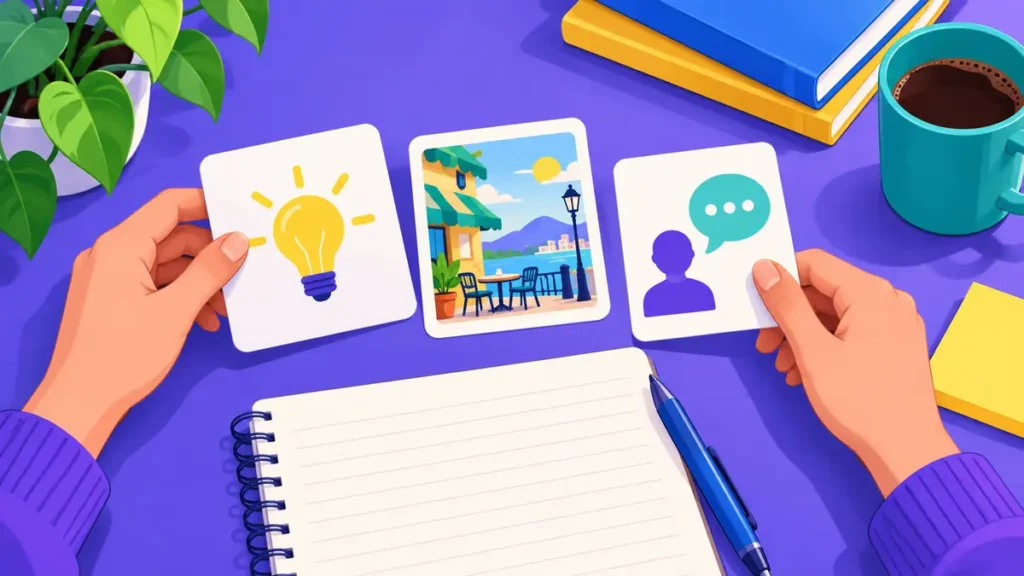
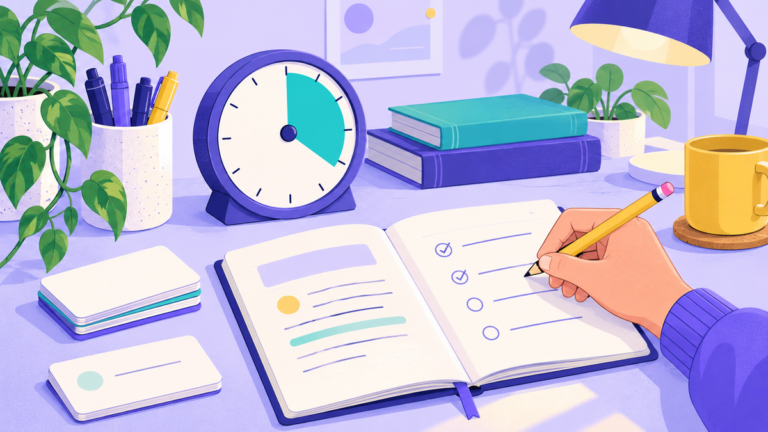
Visual example of cards combining a cue, context, and an attempt at retrieval.
How to create flashcards for language learning in 5 steps
- Choose a small scope. Select words or expressions from a lesson, video, conversation, or recent reading. Ten useful items are worth more than an enormous list you will never review.
- Decide the direction of the question. Sometimes ask for the meaning of a foreign word; at other times, start with a situation in Portuguese and produce the expression in the target language. Changing direction helps you avoid recognizing something without being able to use it.
- Add a plausible sentence. Prefer examples connected to your routine: work, travel, studies, games, or personal interests. The aim is to make clear when the expression fits.
- Test yourself before checking. Give yourself a few seconds to answer. Say or write your attempt, and only then flip the card. Even an incomplete answer is an opportunity for feedback.
- Mark uncertain items. Instead of discarding difficult cards, set them aside for an earlier review. Easy ones can appear less often.
How to review without turning your deck into a chore
Start with a short, repeatable session. Choose a few language learning flashcards, try answering without looking, and make a simple mark: answered confidently, answered hesitantly, or could not remember. This mark helps you decide what deserves attention in your next session.
One possible routine is to review new cards on the day you create them, return to them the next day, and then revisit the items that still cause uncertainty. No single interval works for everyone; adjust the frequency to your schedule and performance. The essential thing is to return to the cards over time instead of cramming everything into one evening.
After answering, check the entire sentence. If you made a mistake, do not just read the solution: try saying it again. This second attempt helps complete the cycle of retrieval and correction.
Common mistakes when creating language flashcards
- Cards that are too long: turn a lengthy explanation into several small questions.
- Translation without context: add a sentence, situation, or image when it clarifies usage.
- Flipping the card immediately: allow yourself real time to search for the answer.
- Reviewing only what is easy: keep the cards that cause hesitation visible.
- Using examples you would never say: adapt the content to your everyday life to make it more meaningful.
Organize the material before turning it into cards
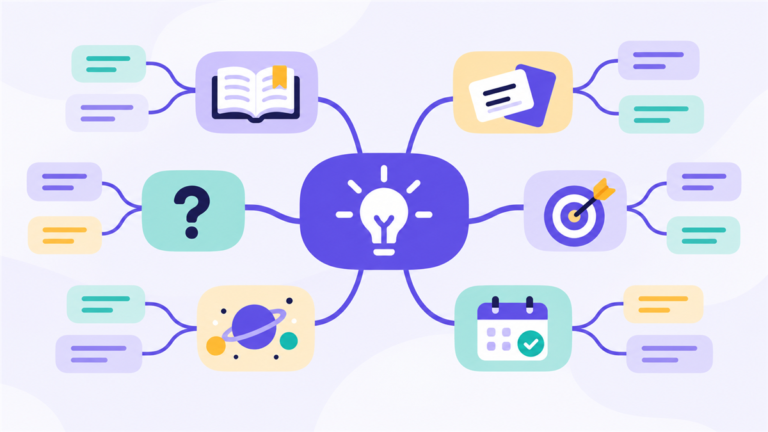
When vocabulary comes from a lesson or a text, it is worth organizing it by topic before creating questions. A mind map can help group expressions for travel, work, food, or introductions. Each branch can then generate language learning flashcards with a clear purpose.
In REAZLY, you can organize topics visually and turn the points you want to review into your own questions. Start with a topic from your next lesson and write three cards with context instead of trying to build an entire deck at once.
Start with a small set
Today, choose five words or expressions that appeared recently in your studies. For each one, write a specific question, add context, and make your first attempt at answering before checking. With this first set, you will already have language learning flashcards ready for a short review tomorrow.
Frequently asked questions
Should I write the translation on the back?
For beginners, a translation can help with quick checking. As your knowledge grows, try using an image, a simple definition in the target language, or a sentence that lets you infer the meaning.
How many cards should I create per day?
Choose a number you can review later. Starting with a few language learning flashcards and staying consistent is usually more useful than accumulating many items without returning to them.
Can I use cards for pronunciation?
Yes. Use a word or phrase as a cue, try pronouncing it, and then check a reliable audio source or your lesson material. Add a short note only when it helps distinguish important sounds.
Ready to create your first mind map?
Organize your ideas in Reazly and turn each concept into flashcards to study and remember.