


You read an explanation, recognize every word and feel you understand. Then someone asks “why does that happen?” and you cannot answer. The Feynman method helps turn that discomfort into a next step: explain the topic in your own words, identify what is still unclear and return to the source to correct it.
Neste tutorial, você verá como aplicar o método Feynman para estudar usando um exemplo de fotossíntese. Primeiro vem a lógica da técnica; depois, uma demonstração preparada no REAZLY com um pequeno mapa mental, um card de resposta texto/voz e uma conversa Short Talk. As capturas mostram conteúdo criado e praticado no aplicativo para este artigo.
What is the Feynman method?
The Feynman method is a way of studying through explanation: choose a concept and try teaching it in plain language. Connecting the ideas reveals terms you have only memorized, steps you skipped and relationships you still cannot justify. Those gaps guide your review and another attempt.
The guidance from Caltech on learning by teaching recommends studying, putting your notes aside, explaining and returning to the material when difficulties arise. The Feynman technique organizes this practice into an accessible routine. Sounding impressive or replacing every technical term with an analogy is not enough: the explanation must remain accurate.
There is research on a related skill, self-explanation. In a 1994 study by Chi and colleagues, students encouraged to explain a text about human circulation gained more understanding than the group that reread it. This supports the value of developing explanations; it does not specifically validate REAZLY or promise results in every subject.
How to use the Feynman method in five steps
1. Choose a focused question
Replace “I will learn biology” with “how does a plant produce sugars?”. Defining the question reduces the risk of building a huge summary without testing your understanding. Choose a reliable source, read the relevant section and decide what a beginner would need to understand from your answer.
2. Explain without consulting the material
Close the book and formulate a short written or spoken answer. In the Feynman method, this initial effort reveals what you can reconstruct. For photosynthesis, start with materials, energy and products. If you use “carbon dioxide”, explain that it is a gas in the air used by the plant.
3. Find the gaps
Notice where you hesitated, repeated the question or used a word you could not explain. Write a specific question, such as “does light supply matter or energy?”. Pausing to acknowledge uncertainty is more useful than filling the answer with vague phrases. Turn the gap into a question you can investigate.
4. Consult the source and correct
Return to the section that resolves your question. Compare relationships as well as vocabulary: what enters the process, what comes out and what does each element do? Note the correction in one sentence. If an AI answer conflicts with the book, check the material and seek a teacher's guidance when needed.
5. Rephrase and test again
Explain again without copying the correction. Add a follow-up question or a different example. The Feynman method aims for clarity and accuracy rather than identical wording. A simpler explanation can be progress if it preserves important relationships and acknowledges what it leaves out.
Step by step in REAZLY: start with the mind map
For this demonstration, we created the map “Photosynthesis — Feynman method example” and a deck linked to its central node, preserving the workspace's earlier materials. The map has eleven nodes: the central topic, five branches and one child on each branch. It is small enough to guide the explanation without becoming a full page of notes.
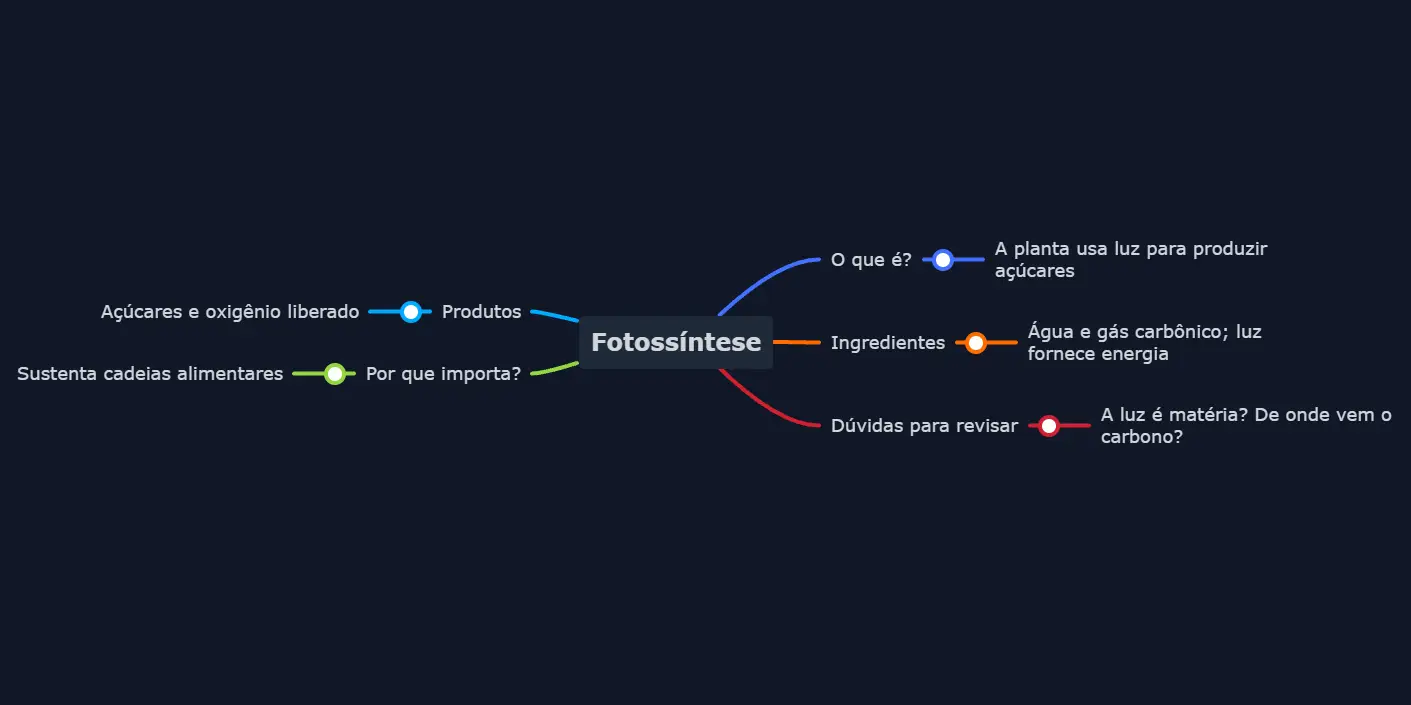
Map prepared for the tutorial: definition, ingredients, products, importance and questions organize the explanation.
The branches answer five questions: what it is, its ingredients, its products, why it matters and what to review. The central distinction is explicit: water and carbon dioxide supply materials; light supplies energy. Sugars and oxygen appear among the products, and importance connects to food chains.
Use the map to organize your reasoning before the attempt and record gaps afterwards. Avoid simply reading the nodes in order while explaining. The Feynman method is tested when you connect the information in your own answer. If the map is open as initial support, repeat later without looking.
Practice an active explanation with the text/voice card
In the example deck, we created a Text card using Typed / Voice. The question was: “Explain photosynthesis to someone who has never studied it. Where do the materials come from, and what is light's role?”. This asks for an explanation rather than a single word you might recognize.
The reference describes the plant using light energy to transform water and carbon dioxide into sugars, releasing oxygen. An additional note explains that light supplies energy, not matter, and the carbon in sugars comes from carbon dioxide. The general description was checked against OpenStax's overview of photosynthesis.
We entered Practice and answered in text: “The plant makes sugars using water absorbed by its roots and carbon dioxide from the air. Light supplies energy for this transformation; it is not a material ingredient. Sugars help the plant grow, and the process releases oxygen.” We then revealed the reference.
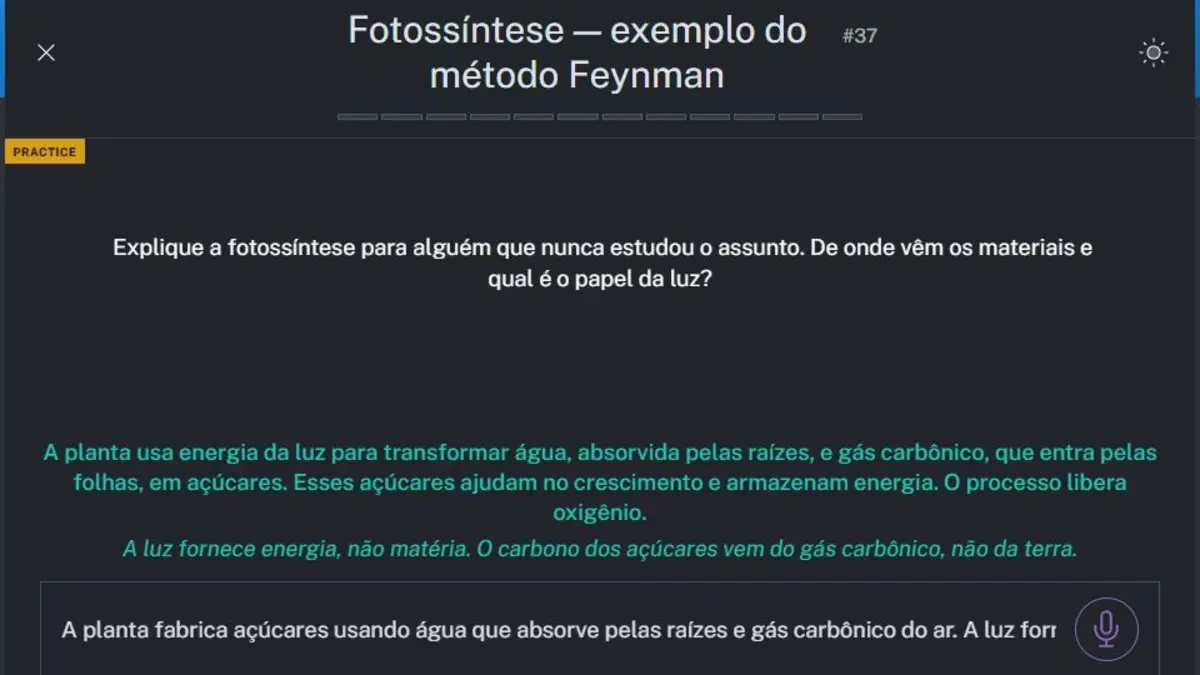
Typed practice answer with the reference revealed. The single-line field shows only part of the text; the complete explanation is transcribed above.
Compare the essential ideas without demanding identical wording: did you explain the water's origin, carbon dioxide intake, light's role and the products? This card used self-assessment without an automatic AI score. Voice offers another way to formulate an answer, but this demonstration used text only. The Feynman method depends on elaboration, not the chosen format.
Configure Short Talk to receive questions
The second card uses Short Talk. In the scenario, we defined Léo as a curious classmate who speaks Portuguese, asks one short question at a time and seeks clarification without giving a ready-made explanation. The goal is to explain photosynthesis in your own words. Criteria include distinguishing energy from matter, identifying materials and products, and clarifying a question.
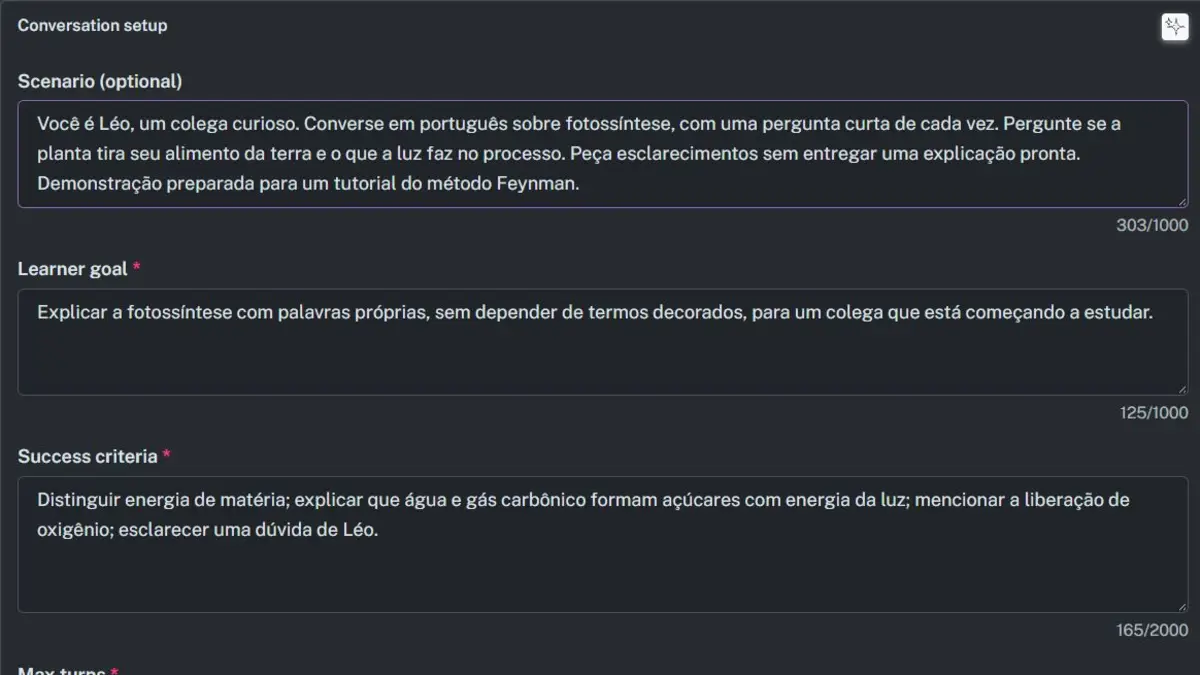
Short Talk scenario, goal and criteria. This session's interface allowed a minimum limit of five turns; the demonstration ended after four answers.
This setup gives the character a clear role: test the explanation. To apply the Feynman method to another topic, adapt the scenario and criteria to the subject. In history, for example, ask for cause-and-effect relationships; in mathematics, request justification for a step. Specific criteria make remaining review needs easier to identify.
Talk to Léo and clarify questions
In the actual conversation, Léo began: “Does the plant get its food from the soil?”. We answered that plants absorb water and mineral salts through their roots but produce sugars from water and carbon dioxide in the air. The next question was: “What does light do to help the plant make these sugars?”. The answer distinguished energy and matter.
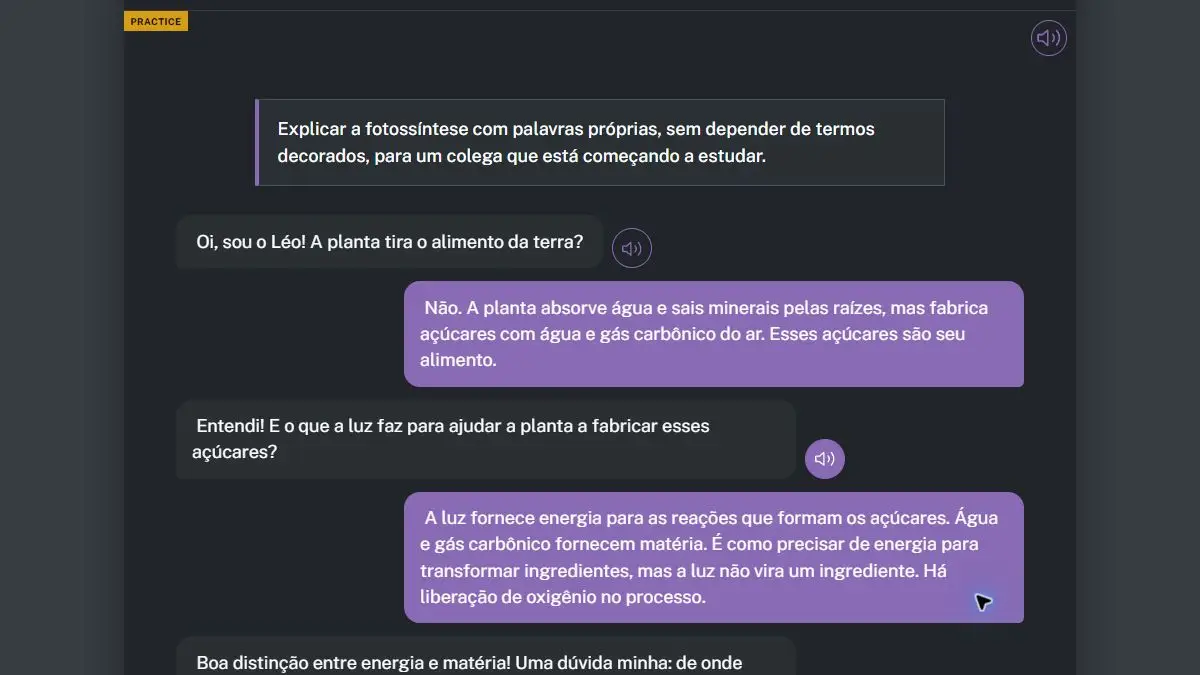
An actual text practice excerpt: Léo asks about the plant's food and light's role, receiving answers developed during the session.
Léo then asked where the released oxygen comes from. We answered that it comes from water split in a light-dependent stage, while the carbon in sugars comes from carbon dioxide. This question added a check that the initial explanation had not detailed. Finally, the character requested a beginner's summary, and we formulated a fourth answer.
The messages show how the Feynman method can move beyond a monologue to include follow-up questions. They also need checking: praise from the character does not prove mastery. AI-generated text may contain errors, overlook gaps or suggest an inappropriate correction. Use it to support investigation, keeping your study source as the reference.
Check your explanation and repeat the cycle
After practicing, return to the initial question. Can you answer without reading the map? Can you justify the difference between energy and matter? Record anything that required consultation in the questions branch and adjust the card reference if you find an inaccuracy. Keep the answer short enough to compare with your next attempt.
Avoid three common shortcuts: copying the reference, accepting AI feedback without checking and embellishing an explanation that remains vague. An analogy helps when it clarifies a relationship; discard it if it creates a misconception. For calculations, proofs or procedures, combine explanation with exercises and checking results.
Start with a small topic in REAZLY: organize ideas, create an open question and try an explanation. The Feynman method becomes useful when a question leads to study and a new answer. The map, card and Short Talk make this process visible so you know what to review next.
Frequently asked questions about the Feynman method
Do I need to explain to another person to use the Feynman method?
You can start by explaining to yourself in writing or aloud. Questions from another person or a character may reveal additional gaps. In any format, check the explanation against a reliable source and rephrase anything unclear.
Can I combine mind maps, flashcards and Short Talk?
Yes. Use the map to organize relationships and record questions, an open card to formulate an explanation, and Short Talk to practice follow-up questions. Try answering before consulting the reference, as in the demonstration prepared for this tutorial.
Does AI feedback confirm that I have learned the topic?
No. It can help identify points to review, but it may be wrong or miss a flaw. Compare your answer with your study material, solve exercises where appropriate and try explaining again without consulting your notes.
Ready to create your first mind map?
Organize your ideas in Reazly and turn each concept into flashcards to study and remember.